








































Are Thicker Motorcycle Gloves Always Better?

Every motorcycle rider knows that the most essential tool in the workshop must be the hands. The rider uses his hands to operate the throttle, control the brake, and signal his intentions to the world. Conversely, most motorcycle riders are trapped in a vicious cycle when it comes to selecting the necessary equipment, believing the saying “more is better.” The question here, especially within the motorcycle community, has long been, "Are thicker motorcycle gloves always better?"
The quick answer is no. But the full answer is much more complicated, relating to abrasion resistance, protection from impact, waterproofing, and, most importantly, tactile feedback.
In this extensive resource, we will explore the realm of motorcycle gloves and examine the benefits of motorcycle gloves made from leather compared to those made from fabrics and explore ways in which technological innovations, such as heated motorcycle gloves, are always pushing the boundaries of "thickness and warmth."
Why We Think Thicker is Better
When you slide your hand into a thick, padded glove, there is an immediate sense of security. It feels like armour. In the event of a slide, you want as much material between your skin and the asphalt as possible. Historically, this meant thick cowhide.
In cold weather, thickness is often equated with insulation. We’ve all been there—trying to ride through a November chill with summer mesh gloves, only to have our fingers turn into popsicles. In those moments, a thick, heavy winter glove feels like a lifesaver.
However, "feeling" safe and "being" safe are two different things. While material thickness contributes to abrasion resistance, it can also hinder your ability to operate the motorcycle safely.
The Case for Thick Gloves: When Bulk Wins
There are undeniable scenarios where a thicker glove is the superior choice.
A. Maximum Abrasion Resistance
In high-speed track environments or long-distance touring, leather motorcycle gloves are often thicker than their street counterparts. Premium cowhide or goat leather provides a sacrificial layer that can withstand the intense friction of a high-speed slide. A thicker hide (usually 1.2mm to 1.5mm) offers more "slide time" before the pavement reaches your skin.
B. Impact Absorption
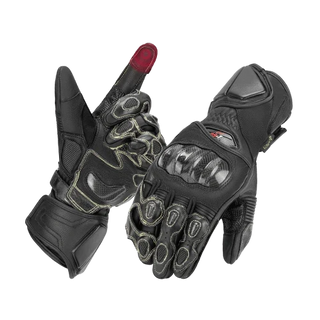
Thicker gloves often house more substantial armour. This includes double-layered leather on the palms (the "slider" area) and thick foam or TPU protectors over the knuckles and finger joints. This mass is essential for absorbing the energy of a direct impact with the ground or an object.
C. Traditional Thermal Insulation
Before the advent of electric heating, the primary method for staying warm was to trap air. Layers of Thinsulate or fleece create pockets of dead air that hold body heat. To get a high CLO rating (the measurement of thermal resistance), the glove naturally had to be thick.
The Hidden Dangers of "Too Thick"
While protection and warmth are vital, excessive bulk introduces three major problems:
I. Loss of Tactile Feedback
The most dangerous aspect of a thick glove is the "numb" feeling. To ride safely, you need to feel the "bite point" of your brakes and the subtle vibrations of the throttle. Thick padding creates a disconnect between your brain and the machine. If you can't feel how much pressure you’re applying to the front brake, you risk a lock-up or an under-braked corner.
II. Hand Fatigue
Thick gloves are often stiff. Every time you pull the clutch or reach for the brake, your hand muscles have to fight against the resistance of the glove’s material. On a long ride, this leads to cramping and forearm pump, which slows your reaction times.
III. Hot and Stuffy
Thick gloves rarely breathe well. In any season other than dead winter, thick gloves lead to sweaty palms. Sweat reduces grip inside the glove and can eventually cause the inner liner to pull out when you remove your hand—a frustration every rider knows too well.
The Modern Solution: Heated Motorcycle Gloves

If you are looking for the ultimate winter solution, check out the Kemimoto Heated Motorcycle Gloves collection. These gloves prove that you don't need three inches of padding to survive a sub-zero ride.
For years, cyclists had a choice: be cold, or be awkward. To keep your hands warm, you wore ‘oven mitt’ gloves so you couldn’t use your turn signals.
Today, heated motorcycle gloves have transformed the market. By incorporating ultra-thin heating elements made of carbon fibre or alloy into the fabric, tremendous heat can be experienced without the added bulk.
Contrary to utilizing five layers of insulation made of polyester, a heated glove relies on a battery or a car connection to provide active heating. This enables the glove to be relatively thin so that the user maintains his or her sensitivity while driving.
If you are seeking the best winter solution, look at the Kemimoto Heated Motorcycle Gloves collection. These motorbike accessories have proven that it is not necessary to have three inches of padding to be able to survive a sub-zero journey.
Material Science: Leather vs. Textile
When discussing thickness, we must discuss what that thickness is made of.
Leather Motorcycle Gloves
Leather remains the gold standard for many. It has a natural ability to "break in" and mould to the shape of your hand.
- Goatskin: Often thinner than cowhide but incredibly supple and high in tensile strength. It’s the favourite for riders who want protection without the bulk.
- Cowhide: Thicker and more traditional, offering the best "heavy-duty" feel.

Textile and Hybrid Gloves
Modern textiles offer incredible abrasion resistance with much less thickness than leather. Many high-end motorcycle riding gloves now use a hybrid approach: leather in the palms for feel and slide protection and textile on the back of the hand for flexibility and airflow.
Explore a variety of styles and materials in the Kemimoto Motorcycle Gloves collection to see how different materials are utilized for specific riding styles.
Finding the "Sweet Spot": What to Look For
So, if thicker isn't always better, how do you choose? Look for these four "sweet spot" features:
-
Palm Construction: The palm should be as thin as possible while remaining durable. Look for unlined leather palms or gloves that use goatskin. You want to feel the texture of your grips.
-
Pre-Curved Fingers: A good motorcycle glove should naturally curve. This prevents the material from bunching up in your palm when you grab the bars—a major cause of discomfort in thick gloves.
-
External Stitching: High-performance gloves often have the seams on the outside of the fingers. This prevents the "thick" feeling of seams pressing into your fingertips.
-
Armour Placement: Look for "floating" knuckle protectors. These are hard shells that stay in place while the glove material moves underneath them, allowing for a thicker protector without restricting movement.
Care and Maintenance — Keep Protection Effective
-
Keep leather clean and conditioned; avoid saturating it with water.
-
For heated gloves, remove batteries before washing, dry naturally, and use the cleaning instructions — batteries and wiring are vulnerable to damage.
-
Replace gloves after heavy crashes or if structural damage (rips, broken armour) is visible. Seams degrade with time; inspect them periodically.
Conclusion
Is a thicker glove better? Only if that thickness serves a specific, ergonomic purpose.
As modern motorcyclists, our goal is to provide the most protection with as little obstruction as possible to the riding experience. We desire the slide protection offered by leather motorcycle gloves, the impact protection offered by hard armour patches, the warmth associated with heated motorcycle gloves, and more.
If you’re still using "marshmallow" gloves that make it difficult for you to locate your turn signal, it’s time for a technological upgrade. The days when such technologies are necessary are long gone. (Here is the best part: you can enjoy an extra 15% off Kemimoto Canada sitewide by using the limited-time discount code "KMSEO"! )
Upgrade your ride today:
- For all-season versatility and protective gear: Browse Kemimoto Motorcycle Gloves
- For cold-weather comfort without the bulk: Explore Kemimoto Heated Gloves
Ride safe, keep your hands warm, and never sacrifice the "feel" of the ride for the "illusion" of thickness.


